
WhatsApp Marketing in India 2026: What Changed and What to Do About It
WaZappy · 12 November 2026 · 7 min read
In this article20 sections
- WhatsApp Marketing in India 2026: What Changed and What to Do About It
- Key Changes for WhatsApp Marketing in 2026
- AI Chatbot Restrictions
- Marketing Message Rate Increase
- Mandatory INR Billing Migration
- Simplified Messaging Limits
- New Charges for Service and Utility Messages
- App and API Coexistence
- What You Need to Do Now
- Review Your AI Implementations
- Optimize Messaging Costs and Quality
- Ensure INR Billing Compliance
- Leverage Simplified Messaging Limits
- Understand API Pricing and Select a Provider
- Choosing the Right WhatsApp Business API Provider
- WhatsApp Business App vs. API: When to Choose Which
- Pricing Considerations for 2026
- Compliance and Best Practices
- Frequently asked questions
- What to do next
WhatsApp Marketing in India 2026: What Changed and What to Do About It
The way businesses connect with customers on WhatsApp in India is shifting. If you're using WhatsApp for marketing, sales, or support, you need to know about the changes coming in 2026. Meta is updating rules and pricing, especially around AI and message costs. Businesses that adapt quickly will keep their edge. This guide breaks down what's new and gives you actionable steps to stay ahead.
Key takeaways
- WhatsApp prohibits general-purpose AI chatbots from January 15, 2026, but allows AI for specific customer service functions.
- Marketing message rates for India increased to ₹0.8631 per message from January 1, 2026.
- All eligible Indian businesses must migrate to INR billing by December 31, 2026, to avoid message delivery issues.
- Verified businesses now have a simplified messaging limit of 100,000 messages per day.
Key Changes for WhatsApp Marketing in 2026
Meta has announced several significant updates impacting WhatsApp marketing in India starting in 2026. Understanding these is crucial for planning your communication strategy.
AI Chatbot Restrictions
A major shift is the ban on general-purpose AI chatbots on WhatsApp, effective January 15, 2026. This means you can't use AI tools like ChatGPT or Copilot as your primary customer interface. However, AI is still permitted for specific, defined customer service tasks such as handling support queries, managing bookings, or processing orders. The focus must be on task-specific AI, not broad conversational agents.
Marketing Message Rate Increase
From January 1, 2026, Meta has increased the rate for marketing messages in India. The new rate is approximately ₹0.8631 per marketing message. This impacts the cost of sending promotional campaigns, so optimizing your lists and message relevance is more important than ever to maintain a positive return on investment.
Mandatory INR Billing Migration
Meta is introducing local billing in Indian Rupees (INR) for eligible Indian businesses. All WhatsApp Business Accounts must complete this migration by December 31, 2026. Failure to do so will result in message delivery disruptions. This change aims to simplify payments and ensure compliance with local regulations.
Simplified Messaging Limits
The tiered messaging limit system has been removed. Verified businesses in India now have direct access to a limit of 100,000 messages per day. This simplifies campaign planning and execution for businesses that need to reach a large audience.
New Charges for Service and Utility Messages
From October 1, 2026, businesses will receive 1,000 free service messages per month per phone number. Any additional service messages will be charged at ₹0.115 each. Furthermore, utility templates sent within an open customer service window are also now subject to charges. This means careful management of conversation windows and message types is essential.
App and API Coexistence
It's now possible to run both the WhatsApp Business App and the API on the same phone number. While this offers flexibility, some features of the app might be disabled when used alongside the API. This is a useful option for businesses testing the waters or those with specific needs.
What You Need to Do Now
With these changes, a proactive approach is key. Here’s how to prepare your business for WhatsApp marketing in 2026.
Review Your AI Implementations
Ensure any AI chatbots you use comply with the new policy. Focus on AI that performs specific customer service functions. If your current AI is a general-purpose chatbot, you'll need to adjust it or replace it with a task-oriented solution. This means focusing on efficiency for defined tasks, not open-ended conversations.
Optimize Messaging Costs and Quality
The increase in marketing message rates means you must focus on list quality and message relevance. Sending messages to engaged users who have opted in will yield better results and lower costs per conversion. Segment your audience carefully and personalize your communication.
Ensure INR Billing Compliance
Don't wait until the last minute. Migrate to INR billing before the December 31, 2026 deadline. Check your WhatsApp Business Account settings and follow Meta's instructions for migration. This is a non-negotiable step to ensure uninterrupted service.
Leverage Simplified Messaging Limits
With the 100,000 daily message limit for verified businesses, you can plan larger, more ambitious campaigns. Ensure your content is engaging and drives action. This is a great opportunity for scaling your outreach efforts effectively.
Understand API Pricing and Select a Provider
Be aware of Meta's per-message charges for different conversation types (marketing, utility, service, authentication). Beyond Meta's charges, you'll also have Business Solution Provider (BSP) platform fees. Choosing the right best WhatsApp Business API provider in India is critical. Look for providers that offer transparent pricing and robust features.
For D2C and e-commerce, platforms like AiSensy or Interakt are strong contenders. If you're building custom solutions, 360dialog or Twilio are developer-friendly. For large enterprises, Gupshup and Infobip offer comprehensive solutions. SMBs might find WATI or Gallabox simpler to use. For marketing-heavy use cases, AiSensy stands out, while Gallabox is excellent for no-code chatbots. When evaluating top WhatsApp Business API providers, consider your specific needs.
Choosing the Right WhatsApp Business API Provider
Selecting a provider is a strategic decision. Consider these factors:
- Features: Does it offer automation, chatbots, shared inboxes, and analytics?
- Pricing: Is it transparent? Does it align with your budget?
- Support: What level of support do they offer?
- Integrations: Can it connect with your existing CRM or other tools?
WaZappy, by Infrared Techno, is a Meta Tech Provider on the official WhatsApp Business Platform (Cloud API). We offer advanced features like AI-powered chatbots, no-code flow builders, broadcast management, catalog integration with UPI payments, and a shared team inbox, all designed to help Indian businesses thrive on WhatsApp. If you're looking for a platform that simplifies complex tasks and boosts engagement, explore our offerings.
WhatsApp Business App vs. API: When to Choose Which
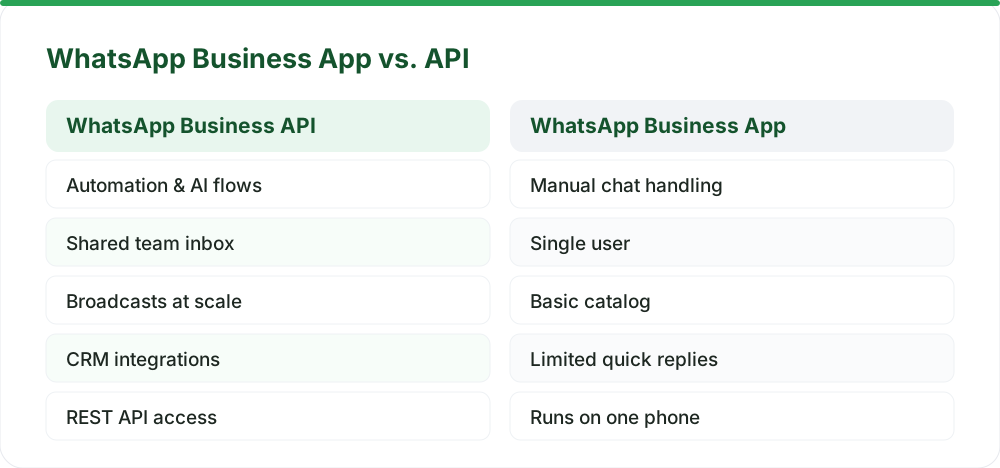
The WhatsApp Business app vs API decision depends on your scale and needs. The app is free and suitable for solo entrepreneurs or small teams managing manual chats. It offers basic features like business profiles and product catalogs for up to 500 items. The API, however, is a paid service designed for larger operations. It integrates WhatsApp with your software, enabling automation, multi-agent support, large-scale template broadcasts, and deeper integrations.
| Feature | WhatsApp Business API | WhatsApp Business App |
|---|---|---|
| Cost | Per-message charges + platform fees | Free |
| Scalability | High (thousands of messages daily) | Low (manual, single device) |
| Automation | Yes (chatbots, flows) | Limited (quick replies) |
| Team Support | Yes (shared inbox) | No (single user) |
| Integrations | Yes (CRM, e-commerce) | No |
| Use Case | Medium to large businesses, customer service, marketing at scale | Small businesses, solo owners, manual customer interaction |
Pricing Considerations for 2026
WhatsApp marketing costs involve two main components: Meta's conversation charges and your provider's platform fees.
- Meta Conversation Charges: These are per-message fees. As of October 2026, marketing messages cost ₹0.8631 each. Utility, authentication, and service messages cost ₹0.115 each after the free allowance.
- Free Allowance: You get 1,000 free service messages per month per phone number from October 1, 2026.
- BSP Platform Fees: Providers like WaZappy charge monthly fees, typically ranging from ₹1,500 to ₹8,000, depending on the features and plan.
The total cost is the sum of these, plus applicable taxes like GST. It's important to understand Meta's conversation categories to manage costs effectively. You can learn more about these WhatsApp conversation categories here.
Compliance and Best Practices
To avoid issues and maximize your ROI, follow these best practices:
- Obtain Explicit Consent: Always get opt-in consent before sending marketing messages. Respect DND registrations.
- Use Approved Templates: All outbound messages must use Meta-approved templates. WaZappy's template manager helps streamline this process.
- Comply with Data Privacy: Adhere to India's data privacy laws, like the Digital Personal Data Protection Act (DPDPA) and the IT Act, for data collection and processing.
- Document Everything: Keep records of consent, message templates, and compliance measures.
- Leverage Click-to-WhatsApp Ads: Use these ads to drive leads directly into automated WhatsApp flows for efficient lead generation and nurturing.
Frequently asked questions
What is the main change for AI chatbots in 2026?
From January 15, 2026, WhatsApp prohibits general-purpose AI chatbots. AI can only be used for specific customer service functions like support or bookings.
How much do marketing messages cost in India from 2026?
The rate increased to ₹0.8631 per marketing message from January 1, 2026.
What is the deadline for migrating to INR billing?
Eligible Indian businesses must migrate to INR billing by December 31, 2026, to avoid message delivery interruptions.
What to do next
The WhatsApp marketing landscape in India is evolving rapidly. By understanding the changes in AI policies, message pricing, and billing, you can adapt your strategy. Start by reviewing your current setup and ensuring compliance. Then, explore how a robust platform like WaZappy can help you leverage these changes for growth.
Read next
All WhatsApp Business API guides →WhatsApp CTWA + Retargeting: A Full-Funnel Strategy for Indian D2C Brands
Discover how Click-to-WhatsApp Ads (CTWA) and intelligent retargeting create a complete sales funnel for Indian D2C brands, driving higher conversions and ROAS.
WhatsApp Drip Campaigns: Recovering Abandoned Carts in India
Turn lost sales into revenue. Learn how WhatsApp drip campaigns, powered by automation and UPI payments, can recover abandoned carts for your Indian business.
Click-to-WhatsApp Ads: Turn Ad Clicks into Qualified Conversations in India
Learn how to use Click-to-WhatsApp ads to generate warmer leads and drive sales for your Indian business. Discover how automation and catalogs can boost engagement.
Want this on your WhatsApp?
WaZappy is the WhatsApp Business API platform with every advanced feature built in — start free and connect your number in minutes.
Start free on WaZappy